
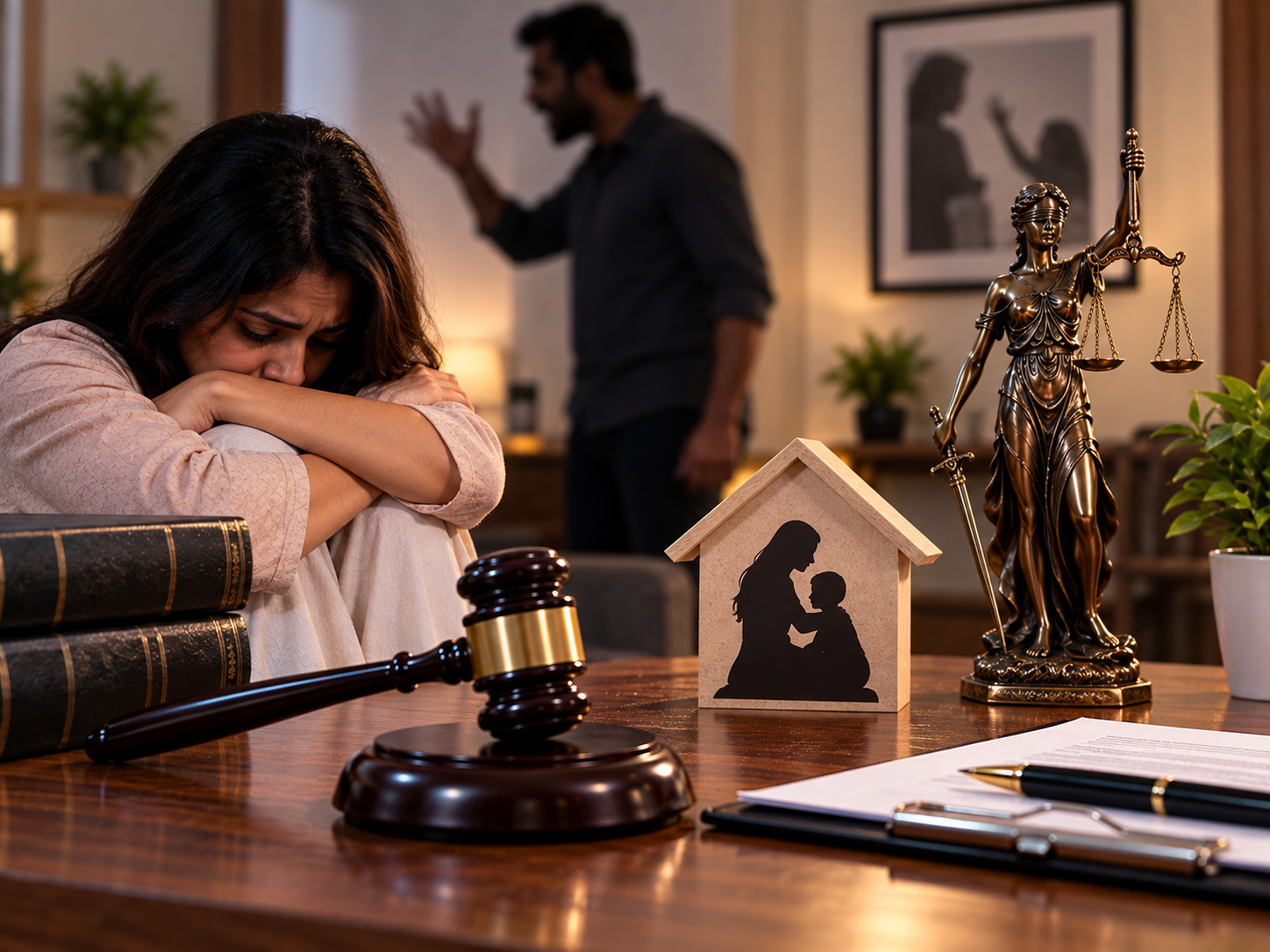
Domestic Violence Case
Domestic Violence Case Lawyer in Noida
Domestic violence is violence or other abuse in a domestic setting, such as in marriage or cohabitation. Domestic violence law in india or DV law have three laws for Domestic violence in India which deals with punishment and Penalty for domestic violence in India.
- The section 498A of the Indian Penal Code
- The Dowry Prohibition Act, 1961
- The Protection of Women from Domestic Violence Act, 2005
As per the Indian Legal system, DV is known for the complaint related to any violence for eg financial, mental, social, physical etc where immediate proof is not available. 498A is considered as more heinous way of complaint, in this complaint a direct FIR can be registered and earlier direct arrests too.
Here are the steps you can take to file a domestic violence case in India and claim maintenance under the Protection of Women from Domestic Violence Act (PWDVA), 2005:
- File a petition in the court: You can file a petition in the Magistrate Court under the PWDVA, seeking protection, compensation, and maintenance for yourself and your child. You will need to provide evidence of domestic violence, such as medical reports, photographs, and witness statements.
- Approach the Protection Officer: Under the PWDVA, every district has a Protection Officer who can assist you with filing a complaint and seeking protection. You can approach the Protection Officer of your district, who will provide you with the necessary information and support.
- Attend the court hearings: Once you file the petition, you will have to attend court hearings and provide evidence to support your case. The court will then decide on the appropriate action to take, such as issuing a protection order, directing the abuser to pay compensation, and ordering maintenance for you and your child.
- Obtain a maintenance order: If the court grants maintenance, you will need to obtain a maintenance order, which is a legal document that states the amount of maintenance to be paid by the abuser. You can then enforce the order through legal means if the abuser fails to comply.
You can approach your local police station and file a First Information Report (FIR) under Section 498A of the Indian Penal Code (IPC), which deals with cruelty by a husband or his relatives towards a woman. The police will conduct an investigation and take necessary action. If you wish to know more about Mutual Divorce or Contested Divorce, contact one of the best divorce advocate in Noida.
Now check out the step by step procedure involved to file a Domestic Violence case:
Option 1: Registering a complaint before Police- Here, the police will file a First Information Report (FIR), a Domestic Incident Report (DIR), or they will point the victim in the direction of the local Protection Officer in charge.
- The first point of contact for domestic abuse cases in a district is a protection officer. The victim will be assisted by a protection officer in filing a DIR and a court case.
- The perpetrator of domestic violence, or any witness to the crime, may submit a FIR or complaint on the victim's behalf with the local police officer, the protection officer, the service provider, or the Magistrate. The judge of the court where either the victim or the accused lives, or where the offence was committed, hears cases of domestic violence.
- Both the parties will have to appear before the family court after the filing of the petition.
- Within three days of the complaint's filing, the magistrate must begin hearing the matter after receiving the complaint.
- The Magistrate must also give the Protection Officer the notice of the hearing date so they can give it to the Accused.
- The court must, in the majority of cases, decide the case within sixty days of the first hearing.
- You can even ask the Magistrate to conduct the hearing in secret, meaning you won't need to show up in person and the hearing will be conducted via video conference.
- The court may issue any of the following directions as it may seem necessary in the circumstances of the case, provided it is convinced that a real domestic violence case was filed and the accused truly committed the offence (you can also request the court to pass any of these orders):
- Protection orders: These orders allow the court to further limit the accused from abusing you or any of your family members and even forbid them from entering your home or place of employment. You may get a protection order as an interim relief, that is, before the final judgement is rendered.
- Residence orders: The court may prevent the accused from ejecting you from your marital home and may even forbid him from entering the part of the home where you are residing if it is convinced that you have nowhere else to go or for any other reason.
- Financial relief: You may also seek the court to order the accused to pay for your medical costs and any other losses that you have incurred as a result of the offence being committed.
- Child custody: The applicant may also be given interim custody of the child(ren) in question by the court.
- Compensation orders: In addition to the aforementioned reliefs, the magistrate has the authority to order the accused to pay damages and compensation for injuries, such as mental anguish and emotional distress, brought on by acts of domestic violence.
Until the victim files a request with the court to have them revoked, these orders will be in effect. If the court does rule in the favour of the victim, you have thirty days from the date the ruling is made to file an appeal against the ruling.
Case under IPC: A three-year prison sentence, a fine, or both may be imposed as punishment for the crime of domestic violence under section 498A of the Indian Penal Code, 1860. As a result, the husband or his relative can be the subject of an FIR at the neighbourhood police station in your area for an offence under Section 498A. One can also seek legal advice from a professional with experience in handling domestic violence cases.